
(231)-889-4081 | Worship every Sunday @ 10 a.m
(231)-889-4081 | Worship every Sunday @ 10 a.m
Engage with our most recent sermons.

“GOD: AN E.O.E.?” A SERMON BASED ON MATT. 20:1-16 AND EXODUS 16:2-15 delivered on Sunday September 20, 2026 by the Rev. Alison Dutton Jacobs at the First Congregational UCC of Onekama, Michigan.
As we hear Dan read our scriptures, we have to ask ourselves: What’s going on here? Our protestant work ethic and sense of equal pay for equal work—our sense of black and white—right and wrong–no compromise fairness—a dollar an hour means “a dollar an hour” not the same pay no matter how many hours have been worked—no matter what the original contract—is totally blown away by this landowner whose apparent disregard for equal pay rights makes us mad. It’s not fair, we say. How could Jesus be supporting such a system? . . .

“Four Hundred and Ninety Times” A sermon based on Genesis 50:15-21; Romans 14:1-12; Matthew 18:21-35 delivered on Sunday, September 13, 2026 by the Rev. Alison Dutton Jacobs at the First Congregational UCC of Onekama, Michigan.
When Peter asked Jesus about forgiveness, he was as usual, a bit clueless. Looking for a human formula for forgiveness that he could follow. When Jesus answers him, he evokes the special biblical number seven and thus brings God into the solution. In the Bible, the number seven symbolizes completion, perfection, and divine order, appearing repeatedly to highlight God’s work and spiritual fulfillment.

“Nearer To Us Now?” A sermon based on Ezekiel 33:7-11; Romans 13:8-14 and Matthew 18:15-20 delivered on September 6, 2026 at the First Congregational UCC of Onekama, MI by the Rev. Alison Dutton Jacobs.
Paul was an optimist or, I suppose a pessimist, depending on how you look at a prophecy that anticipates the coming of the “end times” to be imminent; to be coming soon. In the 50’s—and here I am talking about 50 CE (aka AD)–not the Elvis Presley 50’s—Christians believed that Christ was coming back to save them very soon. “Soon and Very Soon” as the wonderfully memorable lyrics of the modern spiritual by Andrae Crouch says. And, as it is so clear in the Gospel of Mark’s theology from about the same time. In point of fact, the word “immediately” appears some twenty-seven times in what is the earliest and the shortest of the Gospel accounts.
For Paul, this most literally meant that “the night is gone and the day is near” . . .
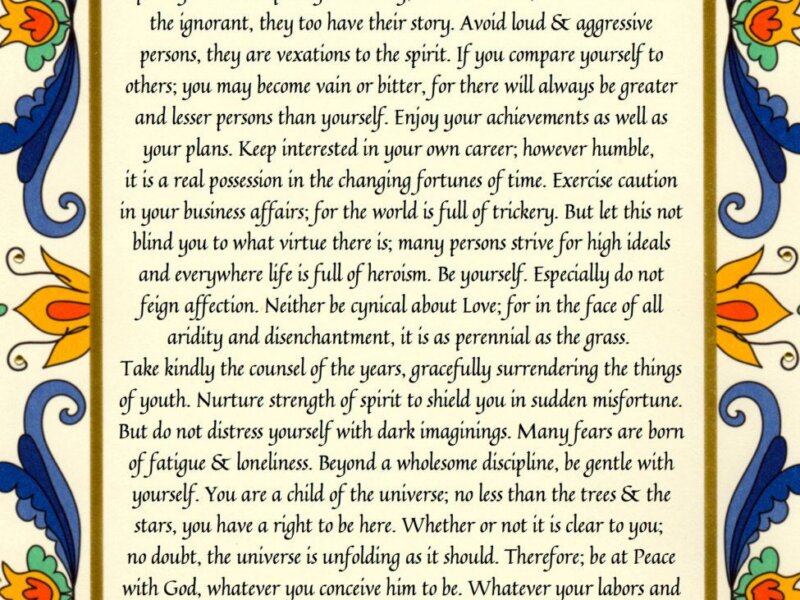
“Desiderata” A sermon based on Jeremiah 15:15-21, Romans 12:9-21 and Matthew 16:21-28 delivered by the Rev. Alison Dutton Jacobs on the 14th Sunday After Pentecost August 30, 2026 at the First Congregational Church UCC of Onekama, Michigan.
Just like Peter, who rebukes Jesus in our Matthew passage this morning, we don’t really like to talk about the Cross. And yet, today we have to do that. For today the scripture is clear about these things. If we are not to be stumbling blocks to Jesus and his message to the world, then we must deny ourselves and take up our cross—whatever that means for us individually—and follow the Christian Way. And we should do this, because it is our deepest desire to repay the gift of life that Jesus’ death on the cross has given us. . . .

“Between a Rock and a Hard Place , ” A Sermon based on Exodus 1:8-2:10; Romans 12:1-8; and Matthew16:13-20 delivered at The First Congregational UCC of Onekama on August 23, 2026 by the Reverend Alison Dutton Jacobs.
As we heard in our Gospel lesson this morning, Peter declares a strong confession of faith in Jesus as “the Messiah, the Son of the living God” at Caesarea Philippi. Peter does this in answer to Jesus” questioning of the disciples” view of what is his true identity. As you can imagine there was at this time much speculation as to the identity of this Galilean miracle worker, and all of the Synoptic gospels are interested in making sure that their readers know beyond a shadow of a doubt that Jesus was not just another one of the prophets, but that Jesus and the Messiah are one in the same. . . .

“Beautiful Dreamer” A sermon based on Genesis 37:1-4; 12-28; Psalm 105:1-6;16-22;45b and Romans 10:5-15 delivered on Sunday, August 9, 2026 by the Rev. Alison Dutton Jacobs at the First Congregational UCC of Onekama, Michigan.
When Andrew Lloyd Webber and Tim Rice wrote “Joseph and the Amazing Technicolor Dreamcoat,” which was first performed in 1968 to a less than enthusiastic audience, they could not have known just how popular it would become. It wasn’t until after the success, amid controversy, of their Rock Opera “Jesus Christ Superstar” in 1971 that the Joseph musical was remembered and revitalized. Its original Broadway production ran for 747 performances and there have been more than 20,000 performances since in various venues.. . .

“Buried Treasure” A sermon based on Isaiah 44:6-8; Psalm 139:1-12;23-24; and Matthew 13:31-33, 44-52 delivered on July 19, 2026, by the Rev. Alison Dutton Jacobs at the First Congregational UCC of Onekama, Michigan.
Jesus mostly spoke in parables. This section of Matthew’s Gospel is nothing but one parable after another strung together like pearls on a necklace. These parables, each one a gem in itself, are often called the “Parables of the Kingdom.” Jesus spoke in parables because he was trying to describe, by use of metaphor, by storytelling and examples, something that is indescribable. What would God’s kingdom be like? Inquiring minds want to know! . . .

“Cutting the Mustard” A sermon based on Psalm 119:129-136, Romans 8:26-39 and Matthew 13:31-32 delivered on Sunday, July 26, 2026 by the Rev. Alison Dutton Jacobs at the First Congregational UCC of Onekama, Michigan,
Mustard and I have a troubled relationship. When I use it on some type of food or other or cook with it, I somehow get it somewhere on my body or on my clothes. The worst incidence of this was when I flew back from a Mission Trip in Honduras. I was really hungry because we had not been able to eat before we left. So, I got a couple of hotdogs with mustard and onions at the Boston airport. As I walked out of the restaurant, I looked down and realized I had somehow dropped copious amounts of mustard on my light blue dress—everywhere! I needed to change but had left all the clothes I had brought with me at the mission for their distribution for those in need. I only had the Mumu type dress, I had bought as a souvenir, so I had to wear that when we flew to Portland. It was huge, because I bought it as a gift, but at least it didn’t have mustard all over it!
Mustard plants come in three major varieties: White Mustard, also
called yellow mustard (the one I usually have problems with!), which produces mild-flavored seeds that are white to light yellow, you have one taped to your bulletin this morning;. . .

“Sow What?” A Sermon based on Isaiah 55:10-13; Psalm 65:9-13 and Matthew
13:1-9, 18-23 delivered by the Rev. Alison Dutton Jacobs on Sunday, July 12,
2026 at the First Congregational UCC of Onekama, Michigan.
I have always been a little confused by our Matthew passage this morning.
Most of the time Jesus tells a parable, makes a point or gives an historical
reference and then gives no real explanation—he often tells his disciples “Let those
who have ears, listen!” (Matt 11:15; Mark 4:23; and Luke 14:35) and leaves it at
that, as if they will somehow be able to intuitively understand what he is trying to
say.. . .

“A Republic . . . Can We Keep It” A Sermon based on Isaiah 61:1-2a;8-9; Galatians 5:1;4-5; and Luke 4:16-21 delivered on July 5, 2026 for Independence Weekend at the Village Park with the First Congregational UCC of Onekama, Michigan by the Rev. Alison Dutton Jacobs.
I think it is pretty safe for me to say, in this particular group, that we all grew up placing our hands over our hearts and reciting the “Pledge of Allegiance” to the flag each morning to begin our school day. The closing hymn that Bruce Brooks wrote to the tune of Auld Lang Syne uses those familiar words in various ways to remind us of those foundational ideas.
On this 250th Birthday of our nation, the words feel comforting to us, like an old friend. You remember them, don’t you? The pledge starts out with these words, “I pledge allegiance to the flag of the United States of and to the Republic for which it stands.” The pledge became so familiar by repetition, that I know I never really thought about our country as a Republic. We talked a lot about democracy in school but . . .
Email us to receive our monthly newsletter.